
A Seasonal Wonder of the Northern California Coast
Discover a half-mile stretch of pristine coastline where nature performs an incredible transformation
between seasons. This is Fish Rock Beach—a hidden gem protected by the legendary “Banana Belt” microclimate.
Anchor Bay Beach is a 1/2-mile-long seasonal beach. “Seasonal” in that the sand comes in and goes out
according to seasonal weather patterns. Its true placename is Fish Rock Beach, named for the bygone
town of Fish Rock that disappeared in the 1920’s, but strangely, still appears on many maps.
The popular local name of Anchor Bay comes from the tiny resort village perched on the terrace just
above it. This unique beach offers a rare glimpse into the powerful seasonal forces that shape California’s
dramatic coastline.
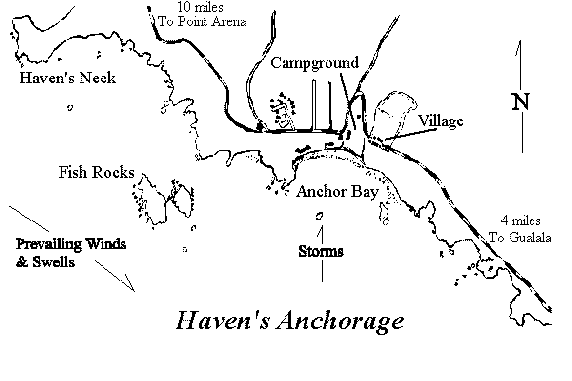
Haven’s Anchorage & Surrounding Area
The Banana Belt Phenomenon: New visitors to Anchor Bay often notice that, from here,
the sun does not set over the ocean. The whole coast from Point Arena to Bodega Bay faces toward the
southwest, but Anchor Bay is like a big bite out of the coast and faces even farther around to the south.
Anchor Bay is protected from the nearly relentless winds that blow out of the northwest. It’s not
unusual to look out and see solid whitecaps and giant swells moving on down the coast, passing us by.
Anchor Bay, then known as Fish Rock Landing, was one of the coast’s “dogholes” where schooners were
loaded with tan bark and railroad ties from a chute on the west point from the 1870’s-1890’s. Our
protected waters have continued to be a haven for today’s commercial fishermen far away from their
home ports. They still find nightly refuge from rough seas while working salmon, rockfish, and urchins
off our coast. There have been as many as 175 boats anchored at one time.
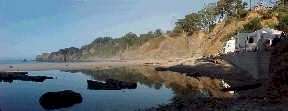
Peaceful summer waters at Anchor Bay
The combination of the coastal shape and the direction of the wind causes a climatic blessing called the
Banana Belt, a nearly fogless micro-climate involving about five miles of coastline with
Anchor Bay set in the middle like a diamond in a golden ring. While the wind blows onshore for the rest of
the coast it is practically offshore here, keeping the fog from drifting in.
North and south of us, summertime motorists are winding along Highway One through the dripping gray, trying
to pierce the fog with their headlights, while we bask under clear blue skies.
The fair-weather ocean swells of spring, summer, and fall approach the California coast from the northwest,
having been generated hundreds of miles away in north-Pacific storm cells. Our prevailing winds, also out of
the northwest, help to push them along and encourage them into good size.
They break directly onto west-facing beaches such as at Manchester Beach and Gualala Point with all the energy
stored in them. While Anchor Bay is spared the direct impacts, the swells do manage to wrap around shallows
and points of land and work their way into the bay, but not without going through a maze of softening effects.
After being broken up, spread thin, and drained of power, the swells are a fraction of their former potential.
They may be breaking 10 feet high on Gualala’s beach but only 1 or 2 feet high here.
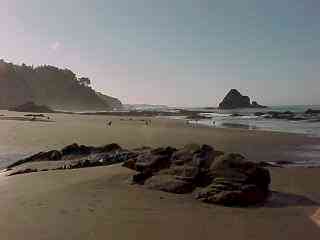
Quinliven Rock at the east end
Anchor Bay’s most attractive feature is its white sand beach. While most of the north coast is dominated
by high cliffs with boulder and cobblestone beaches at their feet, sand collects in pockets like river
and creek mouths and in coves whose shapes persuade currents to deposit rather than to sweep clean.
Anchor Bay is a perfect sand trap.
When the swells are far apart, as happens during fair-weather, there is a shoreward movement of sand as it
is constantly, gently lapped in the one direction. Close to shore, the lightweight grains are suspended in
breaking waves and carried up the beach. The grains fall out of suspension by gravity and join the bottom.
Later, during low tide, the drying sand loses its adhesion, and the grains are picked up by gusts of wind
and moved further up the beach. In this way, the beach builds up day by day, week by week, month by month.
Protected from northwest winds, gentle 1-2 foot waves lap at white sandy shores. The beach builds
gradually over months as sand is deposited grain by grain, creating a pristine coastal paradise.
Commercial fishing boats find safe haven in the calm waters. Families enjoy the rare fog-free skies
of the Banana Belt microclimate.
During storms, the protection is lost. Wind and waves shift to come from the south and southeast with
nothing to block their approach. Anchor Bay faces the full force of the open sea.
Waves begin breaking 100 yards out, forming lines of surf that sweep shoreward in a deafening rumble.
When high tides and storm winds combine, waves sweep across the entire beach to the cliff bottoms.
Spectacular changes occur when nature rages:
Summer’s trickling creeks become voracious torrents that gouge out tons of sand. Rafts of driftwood
trees and stumps are piled like kindling. Whole kelp beds are ripped from their reefs and cast ashore
with some kelp holdfasts still clinging to chunks of rock.
The agitation is so great, tons of suspended sand have no place to settle except in the deeper water
beyond the reach of the boiling breakers. The white sandy beach that took months to build up
can be removed in a single storm.
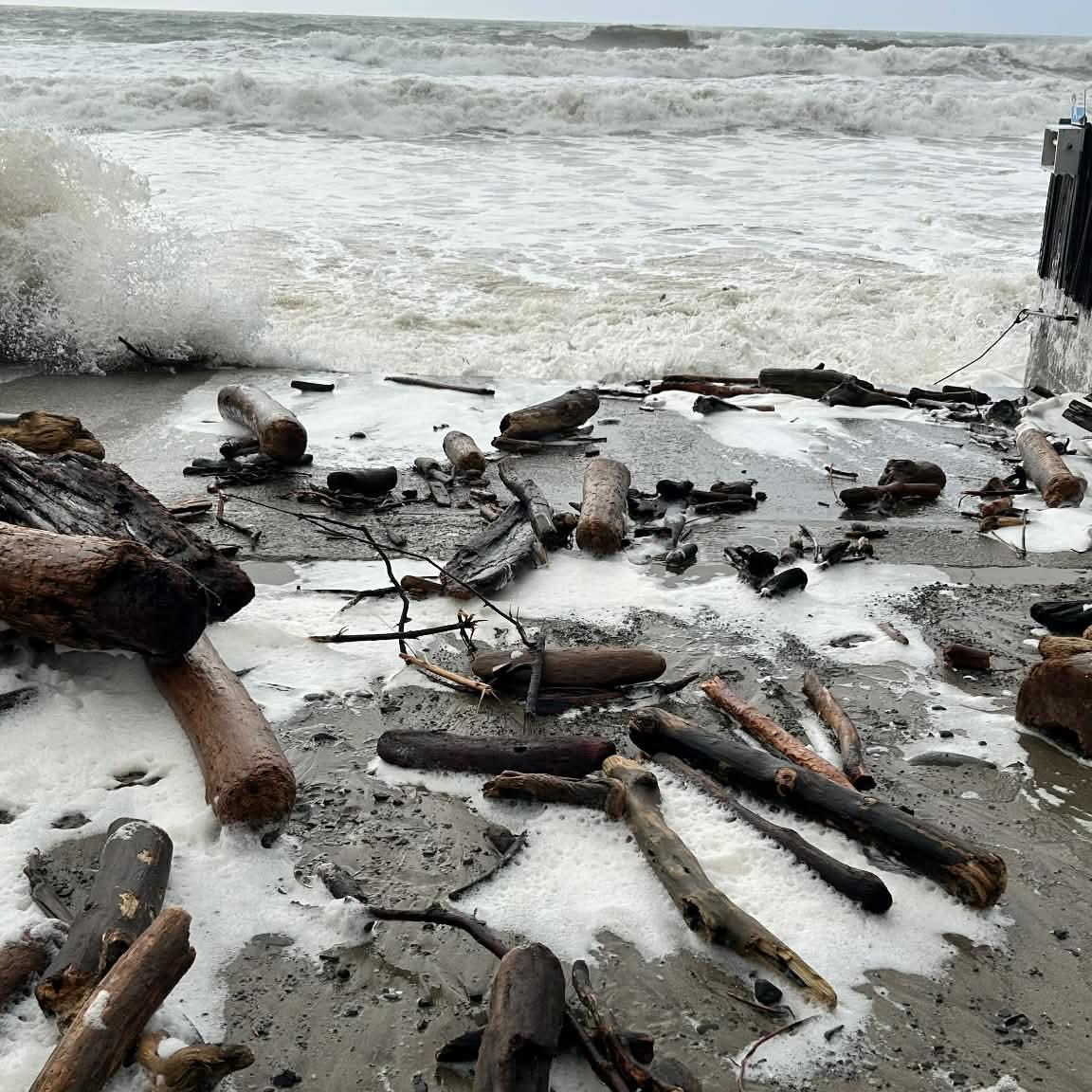
Winter storms transform the bay

Exposed rock formations after the sand departs
After the sand is gone, Anchor Bay’s winter beach takes on the appearance of the rest of the exposed-coast
shingle beaches. Now huge rock outcroppings dominate large sections of beach, some towering several feet
above your head—rocks that lay hidden beneath the summer sand.
Boulders, cobblestones, and pebbles lie in sorted arrangements around log and seaweed sculptures. A few
places are clean down to the bedrock whose surface has been ground to an amazing smoothness.
This smoothness is evidence that the removal of the sand was but a single pass of Nature’s polish cloth,
and that a million such passes have occurred. It stands as the guarantee that the sand will return in season,
just as assuredly as the sun will rise each day.
Camp steps from this incredible beach and witness the seasonal transformation yourself.
Whether you visit during the gentle summer months or the dramatic winter storms,
Anchor Bay offers an unforgettable coastal experience.